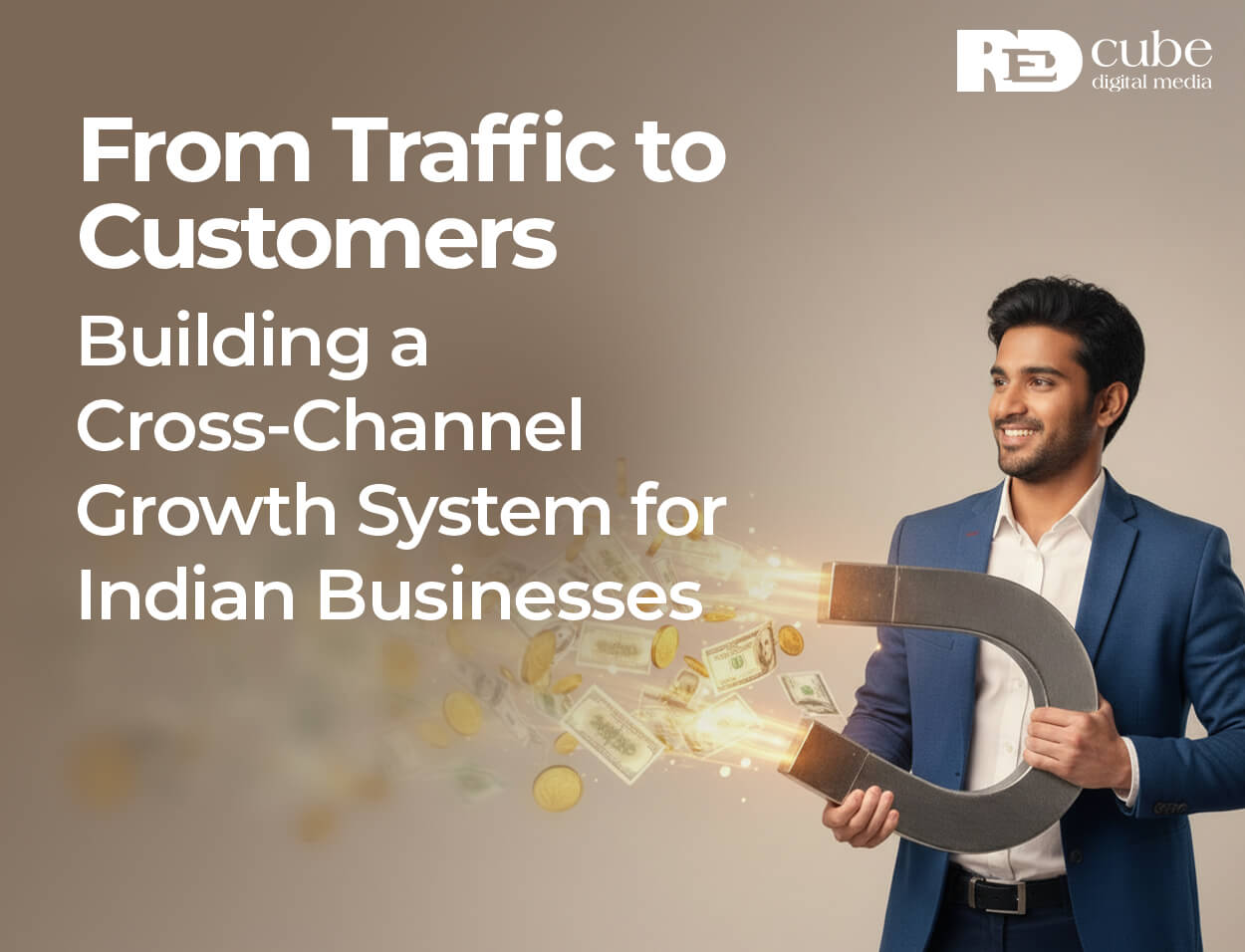
Indian businesses are not losing because they lack online traffic. They are losing because the traffic arrives without direction, context, or continuity.
The website gets visits. The ads get clicks. Social media gets engagement. Yet revenue growth feels fragile and inconsistent. Marketing dashboards look busy, but customer acquisition remains unpredictable. In 2026, traffic without a system is not an asset, it is a leak.
The Indian digital market has matured. The buyers have matured even faster. And the gap between how businesses market and how customers buy has never been wider.
If your digital marketing team still treats SEO, paid ads, social media, and the website as separate units, you are executing disconnected activities, not a unified strategy.
The Question Indian Businesses Must Answer Today
The question has shifted from how to get more traffic to how to turn attention into consistent customer returns. Buyers no longer move in straight lines.
They explore, compare, validate, and return, shifting between devices, platforms, and timelines before making a final decision.
A single buying journey might include:
Before discussing steps, it is crucial to comprehend how ChatGPT (and similar LLMs) generate their responses:
- A Google search during office hours
- A late night YouTube review
- An Instagram reel the next morning
- A WhatsApp conversation with a friend
- A mobile website visit days later
This behaviour is not an exception anymore. It has become the norm.
Yet most digital marketing strategies in India still assume linear funnels and isolated channels. That assumption is costing businesses growth.
Why Traditional Digital Marketing Structures are Failing?
Most Indian businesses structure digital marketing by channel, not by journey.
SEO teams focus on rankings. Paid teams focus on cost per lead. Social teams focus on engagement. And website teams focus on aesthetics.
Each channel reports individual success, but the business does not sense it.
The Three Critical Problems Created by This Approach
1. Inconsistent messaging
Your brand sounds different on search, ads, social media, and your website. Buyers struggle to trust what feels inconsistent.
2. Broken funnels
Traffic enters, but there is no clear path guiding users from awareness to consideration to decision.
3. Misleading metrics
Each team optimizes for its own numbers rather than impacting the revenue.
Indian buyers do not convert after just one interaction. They convert when every interaction reinforces the same promise and value. That is where cross-channel digital marketing becomes a requirement.
What Cross-Channel Digital Marketing Really Means?
Cross-channel digital marketing is not about just being present everywhere, it is about being aligned everywhere. It means every channel plays a defined role within a single marketing funnel strategy.
In a strong cross-channel marketing strategy:
- SEO captures intent and educates early
- Paid ads accelerate proven messages
- Social media builds credibility and recall
- Content reduces confusion
- Websites convert interest into action
- Retargeting and automation close gaps
No channel operates independently. Every channel moves the buyer forward.
The Full-Funnel Framework Winning Indian Buyers
High-performing Indian brands build their digital marketing campaigns around four connected stages.
Stage 1: Intent-driven demand
Awareness without intent is expensive.
Effective demand capture should focus on
- Search content mapped to real buyer questions
- Category and comparison pages should simplify decisions
- Paid search campaigns must align with landing pages built to convert.
Traffic must arrive with purpose. Otherwise it leaves just as quickly as it arrives.
Stage 2: Trust acceleration
Indian buyers validate before they buy.
Trust is not optional, it is built through:
- Consistent messaging across platforms
- Real reviews, testimonials, and case studies
- Educational content that explains outcomes clearly
- Transparency instead of exaggerated claims
When trust is missing, conversions stall. When trust is reinforced, decisions speed up.
Stage 3: Conversion-focused experience design
Your website is not just a brochure. It is your most important salesperson.
High-converting websites focus on:
- Mobile-first experience
- Clear value propositions above the fold
- Focused calls to action
- Fast load times and clean navigation
- Landing pages tailored to traffic sources
Every visit should answer one question clearly. Why should I act now?
Stage 4: Retention and reactivation
Customer acquisition does not end at conversion.
Smart Indian businesses build systems for:
- Email and WhatsApp automation
- Post-purchase education
- Repeat engagement and upselling
- Retargeting based on real behaviour
Retention stabilizes growth and lowers long-term acquisition costs.
Integrated Digital Marketing Outperforms Isolated Efforts
When channels work together, results compound.
- SEO insights improve paid messaging
- Paid data sharpens content strategy
- Social validation improves conversion rates
- Conversion data improves targeting accuracy
- Retention increases lifetime value
This is integrated digital marketing at its most effective. Not more tools, better coordination.
The Most Common Mistakes Indian Businesses Still Make
Despite access to technology and talent, many businesses repeat the same errors:
- Measuring success in silos, prioritizing traffic over revenue outcomes
- Spending heavily on acquisition and neglect conversion
- Treating websites as design projects rather than growth systems
- Trying to copy global playbooks without local adaptation
Growth does not fail because of lack of effort. It fails because of lack of alignment.
Building A Winning Digital Marketing Strategy
A strong digital marketing strategy for Indian businesses today
- Is driven by customer journey
- Is data-informed
- Designed for mobile behaviour and trust sensitivity
- Focuses on long-term value, not short-term spikes
- Is built to scale while maintaining consistency
This approach creates resilience even in a volatile digital environment.
Execution is Where Most Strategies Collapse
Understanding cross-channel digital marketing is not difficult. Executing it consistently is.
Successful execution requires clear ownership across teams:
- Shared KPIs tied to revenue
- Alignment between marketing and sales
- Continuous testing and optimization
- Deep understanding of Indian buyer psychology
Without this foundation, even the best strategies underperform.
The Competitive Advantage Brands Must Build Now
In 2026, digital maturity will separate leaders from laggards.
Brands that invest in full-funnel, cross-channel digital marketing will reduce customer acquisition costs, improve conversion efficiency, build stronger brand recall and will create predictable growth systems
Brands that continue chasing disconnected metrics will struggle to sustain momentum.
Define Your Next Phase of Growth
If every channel you rely on today stopped working tomorrow, how would your business convert attention into customers?
If you want to build a cross-channel digital marketing strategy that converts traffic into customers, RedCube helps Indian businesses design integrated, revenue-focused growth systems. Connect with our team to bring structure, clarity, and measurable outcomes to your digital marketing before investing further in disconnected marketing efforts that do not scale.
Frequently Asked Questions
Q1. What is a cross-channel digital marketing strategy?
A. A cross-channel digital marketing strategy connects SEO, paid ads, social media, content, and conversion optimization into one system so buyers experience consistent messaging and a clear journey from discovery to purchase.
Q2. Why is cross-channel marketing critical for Indian businesses in 2026?
A. Indian buyers research across multiple platforms before purchasing. Cross-channel marketing ensures consistency across touchpoints, builds trust faster, reduces drop-offs, and improves conversion rates in a highly competitive digital environment.
Q3. How is full-funnel digital marketing different from traditional digital marketing?
A. Traditional digital marketing focuses on visibility and traffic. Full-funnel digital marketing addresses every stage of the buyer journey, from intent capture to conversion and retention, making growth more predictable and scalable.
Q4. How does SEO fit into a cross-channel marketing strategy?
A. SEO captures high-intent users early in the journey. When aligned with paid campaigns, content, and conversion optimization, SEO supports revenue growth instead of functioning as a standalone traffic channel.
Q5. What role does a website play in integrated digital marketing?
A. Your website acts as the central conversion engine. It connects traffic from all channels, reinforces trust, communicates value clearly, and guides users toward specific actions that drive measurable business outcomes.
Q6. Can small and mid-sized Indian businesses benefit from cross-channel marketing?
A. Yes. Cross-channel marketing helps smaller businesses allocate budgets efficiently, improve lead quality, and reduce dependency on a single channel, making growth more stable even with limited marketing spend.
Q7. How long does it take to see results from a full-funnel strategy?
A. Most businesses begin seeing improvements within three to six months. Long-term results compound as trust builds, data improves, and customer relationships strengthen across multiple digital touchpoints.
Q8. What are the biggest mistakes Indian brands make in digital marketing?
A. Common mistakes include chasing traffic instead of revenue, measuring channels in isolation, neglecting conversion optimization, and copying global strategies without adapting them to Indian buyer behaviour.
Q9. How should success be measured in cross-channel digital marketing?
A. Success should be measured through shared metrics like conversion rate, customer acquisition cost, lifetime value, and funnel progression, rather than isolated metrics such as clicks or impressions.
Q10. How can RedCube help with cross-channel digital marketing?
A. RedCube helps Indian businesses design and execute integrated digital marketing strategies that align channels, improve conversion efficiency, and build sustainable growth systems focused on long-term revenue.