Ranking for one keyword is not enough if you want your website to get consistent traffic from search engines.
Let’s say you have a website about marketing and you write a great article about “SEO strategy” that starts ranking well. That is a start but you can do a lot more.
You could also write about keyword research, technical SEO, local SEO, content optimization and other related topics.
When your website has a lot of information about a subject Google gets a better understanding of what your website is about and what you are good at.
This is where having a plan for topical authority becomes useful.
A good topical authority plan does not mean writing hundreds of articles. It means creating a planned collection of useful content that covers a subject thoroughly and gives readers a reason to trust your website.
What Is Topical Authority?
Topical authority is about how your website covers a particular subject with useful content.
For example if you have a website about SEO you could write about the basics of SEO, keyword research, technical SEO and other related topics.
These topics are connected. Each one answers a different question.
Google does not give you a score for topical authority that you can check. Instead its systems look at signals to determine how relevant, useful and high-quality your content is.
Google always says that you should create content that’s helpful and reliable and that puts people first rather than just trying to attract search traffic.
Why is topical authority important for search engine rankings in 2026?
Search has become more sophisticated.
A user may search for a topic first and then ask more specific questions.
For example they may search for “SEO” How does SEO work?” then “How do you do keyword research?”. So on.
A website that covers these questions clearly has opportunities to appear in search results throughout the research process.
This is why a good SEO strategy should consider topic coverage rather than treating every keyword as a separate project.
1. Choose a Clear Main Topic
Before creating dozens of articles, decide what your website should be known for.
Your main topic should be:
- Relevant to your business
- Valuable to your audience
- Broad enough to support multiple subtopics
- Closely connected to your products or services
- Something you can realistically create expertise around
For example, a fitness website could focus on:
Strength Training
A financial website could focus on:
Personal Finance
A digital marketing company could focus on:
Digital Marketing and SEO
The clearer the central subject, the easier it becomes to organize your content.
2. Build Topic Clusters
Once you have selected your main topic, break it into smaller categories.
This is often called a topic cluster.
Suppose your main topic is SEO.
Your clusters could include:
SEO Basics
- What is SEO?
- How does SEO work?
- Why is SEO important?
- SEO vs PPC
Technical SEO
- Technical SEO checklist
- Website crawling
- XML sitemaps
- Canonical tags
- Core Web Vitals
Local SEO
- Google Business Profile optimization
- Local keyword research
- Local citations
- Local SEO for small businesses
Content SEO
- Search intent
- Content briefs
- Keyword mapping
- Content optimization
- Content updates
This structure gives your content marketing strategy a clear direction.
3. Create a Strong Pillar Page
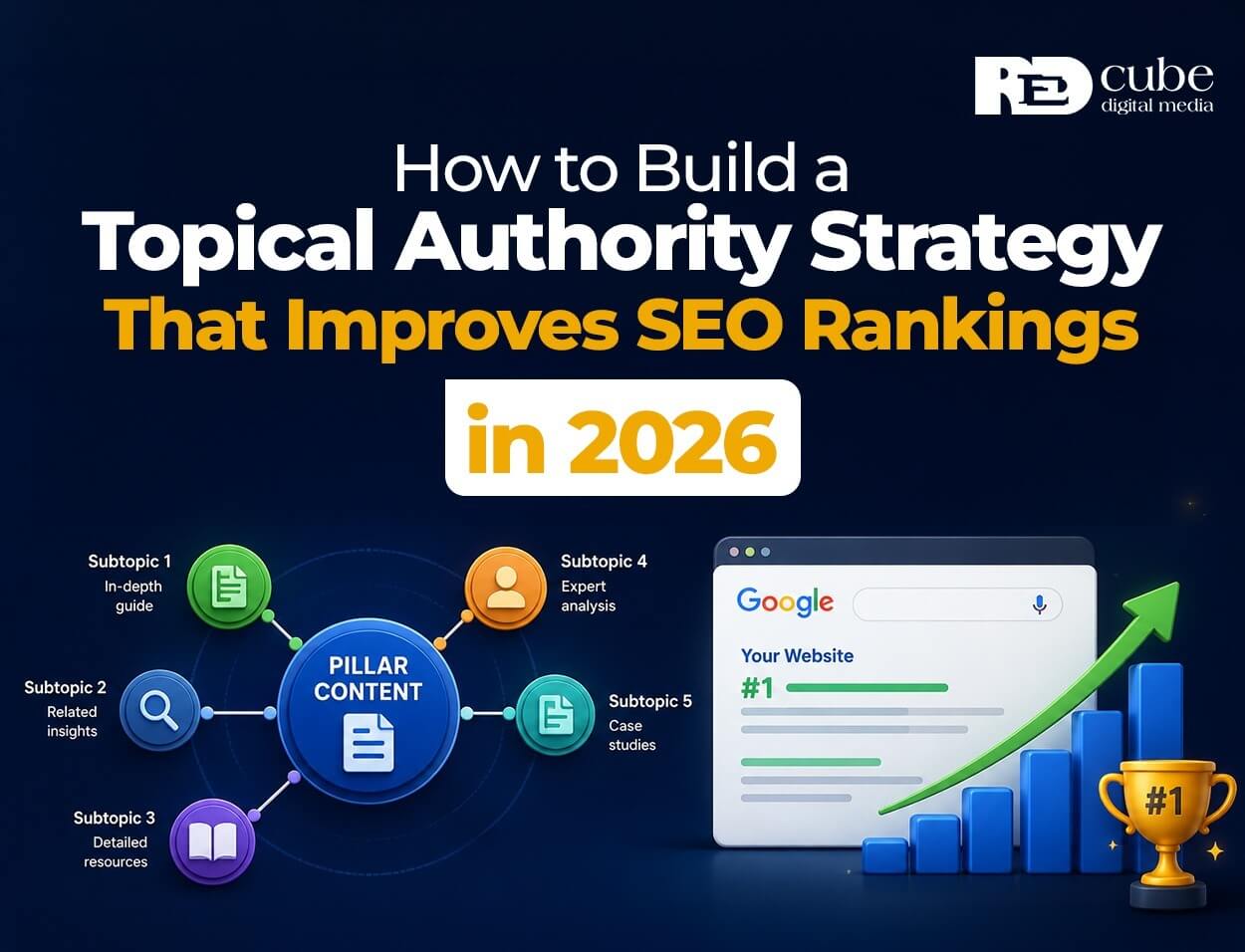
A pillar page provides a broad overview of your main topic.
For example:
The Complete Guide to SEO
The page can explain the fundamentals and then link to more detailed articles.
Your supporting articles can cover:
- Keyword research
- Technical SEO
- Local SEO
- On-page optimization
- Link building
- SEO analytics
The pillar page should provide enough information to be useful on its own. Links should then guide readers toward more detailed resources.
This creates a clear relationship between your pages.
4. Find the Questions Your Audience Actually Asks
A topical authority strategy works better when it starts with real questions.
You can find these questions through:
- Google Search Console
- Google autocomplete
- People Also Ask
- Reddit discussions
- Customer support questions
- Sales calls
- Industry forums
- Competitor content
- Keyword research tools
For example, if customers repeatedly ask:
“How long does SEO take to work?”
That question can become a dedicated article.
If they then ask:
“Why is my website traffic not increasing?”
That can become another article.
5. Focus on Search Intent
Two keywords can appear similar but require completely different content.
Consider:
SEO tools and best SEO tools for small businesses
The first could indicate someone looking for a general list of tools.
The second suggests a specific audience and use case.
Before writing an article, ask yourself:
What does this person actually want to accomplish?
Then create content that answers that need.
6. Connect Your Content With Internal Links
Internal links are important when building topical authority.
Suppose you have an article about keyword research.
Within that article, you might naturally link to:
- Search intent
- Long-tail keywords
- Keyword mapping
- SEO content strategy
Those links help readers discover related information.
They also give search engines additional context about the relationship between your pages.
For example do not use Click because it does not tell people what they will find.
Instead use “Learn how to perform keyword research” because it gives people a lot information about what they will find when they click on the link.This way people know what to expect when they click on the link. That is really helpful.
You should always use keyword research links that’re descriptive like this because they are more helpful, to people who are reading your content.
7. Avoid Publishing Articles That Say the Same Thing
More content does not automatically mean stronger topical authority.
If you publish five articles that essentially answer the same question, you may simply create unnecessary duplication.
For example:
- What Is Local SEO?
- Local SEO Explained
- Local SEO Guide
- Local SEO Basics
- Understanding Local SEO
If all five articles contain nearly identical information, there may be little reason to maintain them separately.
A better approach is to identify the primary intent and create one strong resource, then use supporting pages for genuinely different questions.
8. Demonstrate First-Hand Knowledge
Expertise is easier to communicate when you have something specific to say.
Instead of writing:
SEO is important for businesses.
Give the reader something useful.
For example:
During an SEO audit, you may find that a page receiving thousands of impressions has a very low CTR. Reviewing the title and search intent can reveal an opportunity to improve clicks without creating a new page.
Specific observations, examples, screenshots, original research, case studies, and practical experience can make content more valuable.
Google’s guidance on creating helpful content also asks publishers to consider whether content demonstrates first-hand expertise and provides substantial value.
9. Keep Your Content Updated
Topical authority is not something you establish once and forget.
Your industry changes.
Statistics become outdated. Search features change. Tools release new features. Best practices evolve.
Review important articles regularly.
During a content update, check:
- Statistics
- Sources
- Links
- Examples
- Screenshots
- Search intent
- Keyword relevance
- Internal links
- Competitor content
You do not need to rewrite every article every few months. Focus on pages that are important to your business or already receive meaningful organic traffic.
10. Measure Whether Your Strategy Is Working
A good SEO strategy should be measurable.
Use tools such as Google Search Console and Google Analytics to monitor:
- Organic clicks
- Impressions
- Search queries
- Average position
- Organic traffic
- Engaged sessions
- Conversions
- Top-performing pages
Do not judge your topical authority strategy only by the number of articles published.
A website with 30 highly useful, well-connected articles may perform better than one with 300 weak articles. The quality and relevance of your content matter more than simply increasing the page count.
What the Research Says About Content and Search
Google’s Search Quality Evaluator Guidelines place significant attention on factors such as expertise, experience, authoritativeness, and trustworthiness when assessing the quality of web content.
Google has also stated that its systems are designed to prioritize helpful and reliable information created primarily to benefit people.
This supports an important point for your content marketing strategy: publishing more pages is not enough. Your pages need a clear purpose and should provide information that genuinely helps the reader.
A Simple Topical Authority Plan
If you are starting from scratch, you do not need to publish 50 articles immediately.
Start with a manageable structure.
Month 1
Choose your main topic and create:
- 1 pillar page
- 4 supporting articles
- 1 FAQ resource
Month 2
Add:
- 4–6 supporting articles
- Internal links between related pages
- Relevant updates to existing content
Month 3
Review:
- Search Console data
- Ranking changes
- Organic traffic
- New search queries
- Content gaps
Then decide which topics deserve deeper coverage.
This approach makes your content marketing process more organized and easier to measure.
Frequently Asked Questions
Q1. What is Topical Authority in SEO?
A. Topical authority refers to the depth and usefulness of a website’s content coverage around a specific subject. It involves creating related resources that answer different questions within the same broader topic.
Q2. Does Topical Authority directly improve Google rankings?
A. There is no single Google ranking factor called a “Topical Authority score.” However, comprehensive, useful, relevant content can help your website demonstrate expertise and better satisfy search intent.
Q3. How many articles do you need to build Topical Authority?
A. There is no fixed number. Your required content depends on the size and complexity of your subject. Focus on covering important questions thoroughly instead of aiming for a specific article count.
Q4. What is a topic cluster?
A. A topic cluster is a group of related content pieces organized around a broader subject. Usually, a central pillar page links to more detailed supporting articles.
Q5. How does internal linking support Topical Authority?
A. Internal links connect related pages and help users discover additional information. They can also provide search engines with useful context about how different pages on your website are related.