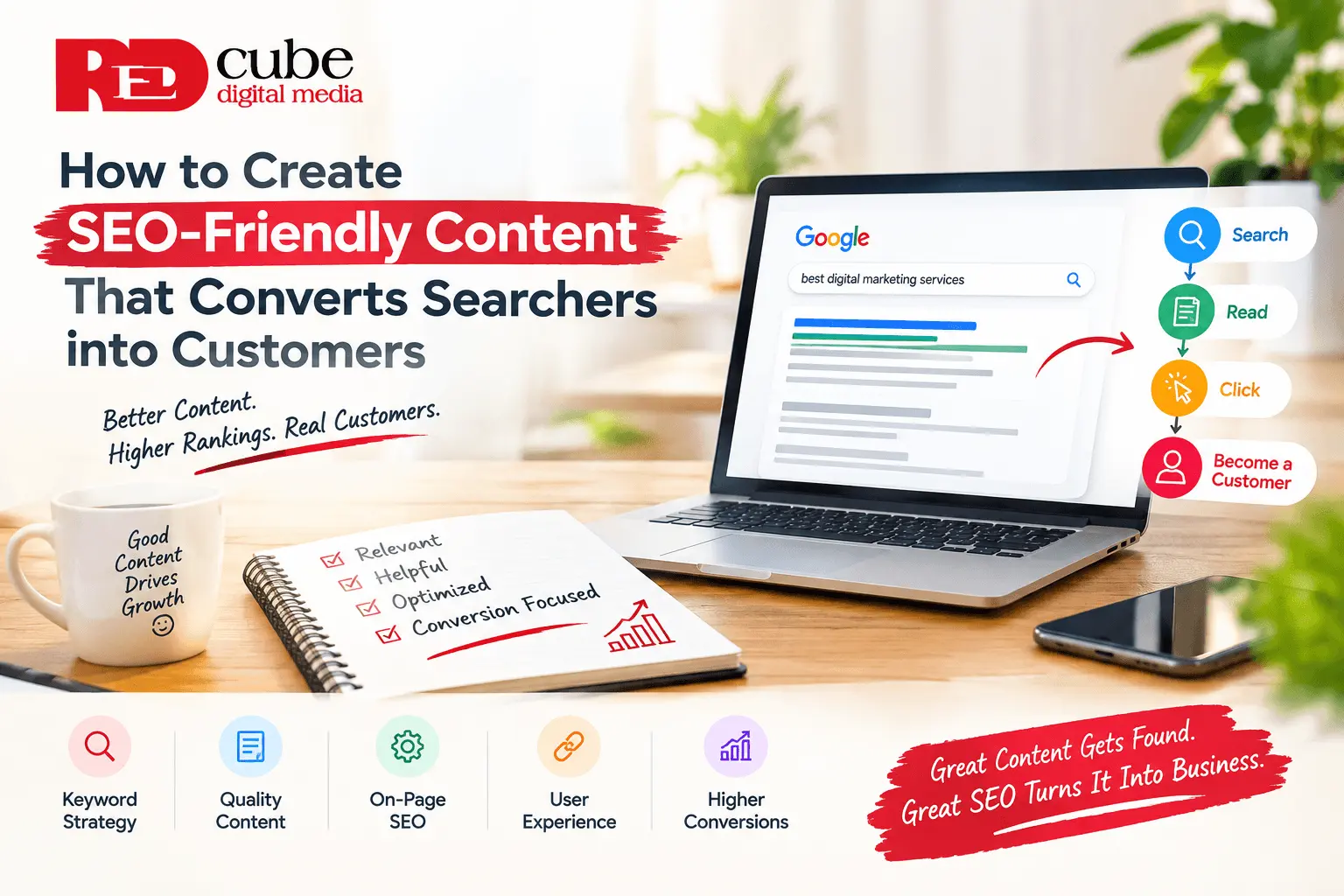
Getting your website to appear on Google is a good start. But ranking is not the final goal.
If people visit your website, read your content, and leave without taking any action, your traffic is not doing enough for your business.
The real value of SEO content comes from connecting search visibility with business results. Your content should answer the question someone searched for, build confidence in your business, and make the next step clear.
That next step could be booking a consultation, requesting a quote, signing up for a newsletter, downloading a resource, or purchasing a product.
This is where content marketing and SEO work together. You need content that search engines can understand and people actually want to read.
What Is SEO-Friendly Content?
SEO-friendly content is content created to satisfy a user’s search intent while making it easy for search engines to understand the topic.
Good SEO content should:
- Answer a genuine question
- Match the user’s search intent
- Use relevant keywords naturally
- Provide useful and accurate information
- Be easy to read
- Have a clear structure
- Include relevant internal links
- Give the reader a logical next step
SEO does not mean inserting the same keyword into every paragraph.
Google’s guidance recommends creating helpful, reliable, people-first content rather than content created primarily to manipulate search rankings. Your priority should therefore be the person reading the page.
1. Start With Search Intent
Before writing anything, understand why someone is searching for the topic.
There are four common types of search intent.
Informational
The person wants to learn something.
Examples:
- What is SEO?
- How does content marketing work?
- How can you improve website speed?
Navigational
The person wants to find a particular website or brand.
Examples:
- Google Search Console
- HubSpot blog
- RedCube Digital Media
Commercial
The person is researching before making a purchase.
Examples:
- Best SEO agency in Delhi
- SEO services for small businesses
- Best CRM software
Transactional
The person is ready to take action.
Examples:
- Hire SEO agency
- Buy SEO software
- Book SEO consultation
Your content should match the intent behind the keyword. An article explaining “What is SEO?” should educate the reader. A page targeting “SEO agency in Delhi” should help the visitor understand your services, expertise, process, results, and how to contact you.
2. Research the Questions Your Audience Actually Has
Your content becomes much more useful when it answers real questions.
You can find these questions through:
- Google autocomplete
- People Also Ask
- Google Search Console
- Customer emails
- Sales calls
- Reddit discussions
- Industry forums
- Competitor content
- Keyword research tools
Suppose you sell website development services.
Instead of writing a generic article titled:
“Why Websites Are Important”
you could address specific questions such as:
- How much does website development cost?
- How long does it take to build a website?
- Should you choose WordPress or Shopify?
- What pages should a business website have?
- How can you improve website conversion rates?
These topics have a clearer purpose and can attract people with specific needs.
3. Choose One Primary Keyword
Every important page should have a clear primary topic.
For example:
Primary keyword: SEO Content
Supporting terms could include:
- SEO-friendly content
- SEO content writing
- search intent
- content optimization
- Content Marketing
- organic traffic
You do not need to force every variation into the article.
Use keywords where they make sense:
- Page title
- Main heading
- Introduction
- Relevant subheadings
- Body copy
- Image alt text where appropriate
- Meta description
- Internal links
Google’s SEO Starter Guide recommends creating descriptive and useful content rather than relying on keyword repetition.
4. Create Headlines That Make the Benefit Clear
Your headline is often the first thing a searcher sees.
Compare:
SEO Content Tips
How to Create SEO Content That Brings More Qualified Leads The second headline gives the reader a clearer reason to continue. Your headline should accurately represent what the page delivers.
Avoid exaggerated promises that your article cannot support. Good headlines are specific, useful, and relevant to the search query.
5. Make Your Introduction Useful
Do not spend half the introduction explaining what the article will discuss.
Get to the reader’s problem quickly.
For example:
You may be getting organic traffic but very few enquiries. This usually means your content is answering search questions without giving visitors enough information or confidence to take the next step.
Now the reader understands the problem and has a reason to continue.
A strong introduction should establish:
- The problem
- Why it matters
- What the reader will learn
Then move into the actual information.
6. Structure Your Content for Easy Reading
People rarely read every word on a webpage.
They scan.
Make your SEO content easy to understand by using:
- Short paragraphs
- Descriptive headings
- Bullet points
- Numbered lists
- Bold text for important points
- Tables where useful
- Examples
- Clear transitions
Long blocks of text can make even excellent information difficult to consume. Your formatting should help readers find the answers.
7. Give Readers More Than the Basic Answer
If the first page of Google already provides a simple definition, repeating the same information will not give your audience much additional value.
For example, an article about SEO audits could include:
- What an SEO audit checks
- Technical SEO issues
- Content problems
- Backlink analysis
- Common mistakes
- Recommended tools
- A practical checklist
- Examples of issues found during an audit
8. Add Trust Signals
People are more likely to contact a business when they understand who is behind the service and why they should trust it.
Depending on your business, include:
- Author information
- Relevant qualifications
- Case studies
- Client results
- Original research
- Customer reviews
- Expert quotes
- References to credible sources
For example, if you publish an article about digital advertising, explaining your team’s practical experience can make the content more credible. Avoid making claims you cannot support.
9. Use Data Carefully
Data may add to the informative nature of an article, but statistics must be based on reliable sources. For instance, the yearly research by the Content Marketing Institute has always indicated that successful B2B marketers have always used content marketing as part of their marketing strategies. When citing statistics:
Verify the year of the publication. If possible, use the original source of the statistic. Clarify what the number actually means.
Do not cite outdated statistics when there is newer data available. Do not cite numbers only to make the article appear knowledgeable. Statistics are relevant if they help the reader understand a business decision.
10. Connect SEO Content With Your Sales Funnel
This is where many businesses miss an opportunity.
Your article may receive thousands of visits, but what happens next?
A reader should have an appropriate next step.
For example:
Informational article
“How Does Local SEO Work?”
↓
Commercial content
“Local SEO Services for Small Businesses”
↓
Conversion page
“Request a Local SEO Consultation”
Your content marketing strategy should connect these stages.
The reader should be able to move naturally from learning about a problem to considering solutions and eventually contacting your business.
11. Use Internal Links Strategically
Internal links help readers discover related information.
Suppose you publish an article about SEO Content.
You could link to related resources covering:
- Keyword research
- Search intent
- Technical SEO
- Content audits
- Local SEO
- Link building
Use descriptive anchor text.
Instead of:
Read more
use:
Learn how to perform a technical SEO audit
This tells both the reader and search engines what the linked page covers.
12. Add Clear Calls to Action
Your CTA should match the reader’s level of intent. Someone reading a beginner’s SEO article may not be ready to purchase an expensive service.
A useful CTA could be: Download the SEO checklist.
Someone reading: How Much Does SEO Cost?
may be closer to contacting an agency.
A stronger CTA could be: Request an SEO consultation. Your call to action should feel relevant to the content the visitor has just consumed.
13. Measure Whether Your Content Converts
Traffic alone does not tell you whether your SEO content is working.
Track:
- Organic clicks
- Impressions
- Search queries
- Rankings
- Engagement
- Leads
- Form submissions
- Phone calls
- Purchases
- Conversion rate
Google Search Console can show you which searches bring people to your website, while analytics tools can help you understand what visitors do after arriving.
Suppose one article receives 10,000 visitors but generates two leads. Another receives 1,500 visitors and generates 35 leads.
The second article may be far more valuable to your business.
This is why your content marketing strategy should measure business outcomes rather than page views alone.
A Simple SEO Content Process
You can use this process for your next article:
Step 1
Choose a topic relevant to your business.
Step 2
Research the search intent.
Step 3
Identify the primary keyword and related terms.
Step 4
Study the questions your audience asks.
Step 5
Create an outline that answers those questions.
Step 6
Write for the reader first.
Step 7
Add examples, data, sources, and practical advice.
Step 8
Add internal links and a relevant CTA.
Step 9
Optimize the title, headings, URL, images, and metadata.
Step 10
Track performance and update the article when necessary.
The Final Note
SEO-friendly content needs to achieve two objectives.Not only does it need to assist search engines with understanding your content, it must also motivate visitors to stay, read, and take action.That means a lot more than just using keywords.
To produce quality SEO content you must know how to determine search intent, answer user’s questions, structure information, provide reliable sources, build expertise, use internal linking, and offer a relevant call to action.Content marketing strategy will become significantly more powerful when each post has its own goal.Not only will you be able to ask yourself:
“How are we going to get this article ranked?”
but also: “What are we supposed to do once the reader finishes reading it?”
The second question might allow you to produce value-adding content not connected with search engine traffic.
Are you ready to convert your website’s content into an organic lead generation machine?
Begin with analyzing your existing articles. Find out which of them attract traffic but have low number of inquiries, and optimize their search intent, structure, authority, internal links, and calls to action.
Share your experience with those strategies that work well for your business.
Frequently Asked Questions
Q1. What is SEO content?
A. SEO content is content created to satisfy a user’s search intent while being structured and optimized so search engines can understand its subject and relevance.
Q2. How does SEO content help generate customers?
A. Effective SEO content attracts people searching for problems, questions, products, or services related to your business. By providing useful information and a relevant next step, you can move visitors toward enquiries, purchases, or other conversions.
Q3. Is keyword density still important?
A. Keyword usage matters, but there is no ideal keyword density that guarantees rankings. Focus on using relevant terms naturally and covering the subject comprehensively.
Q4. What is the difference between SEO and content marketing?
A. SEO focuses on improving visibility in search engines, while content marketing focuses on creating and distributing useful content for an audience. The two can work together to attract and convert relevant visitors.
Q5. How long should SEO content be?
A. There is no universal word count that guarantees rankings. Your article should be long enough to answer the user’s question properly. A simple question may need 500 words, while a complex topic may require 2,000 words or more.